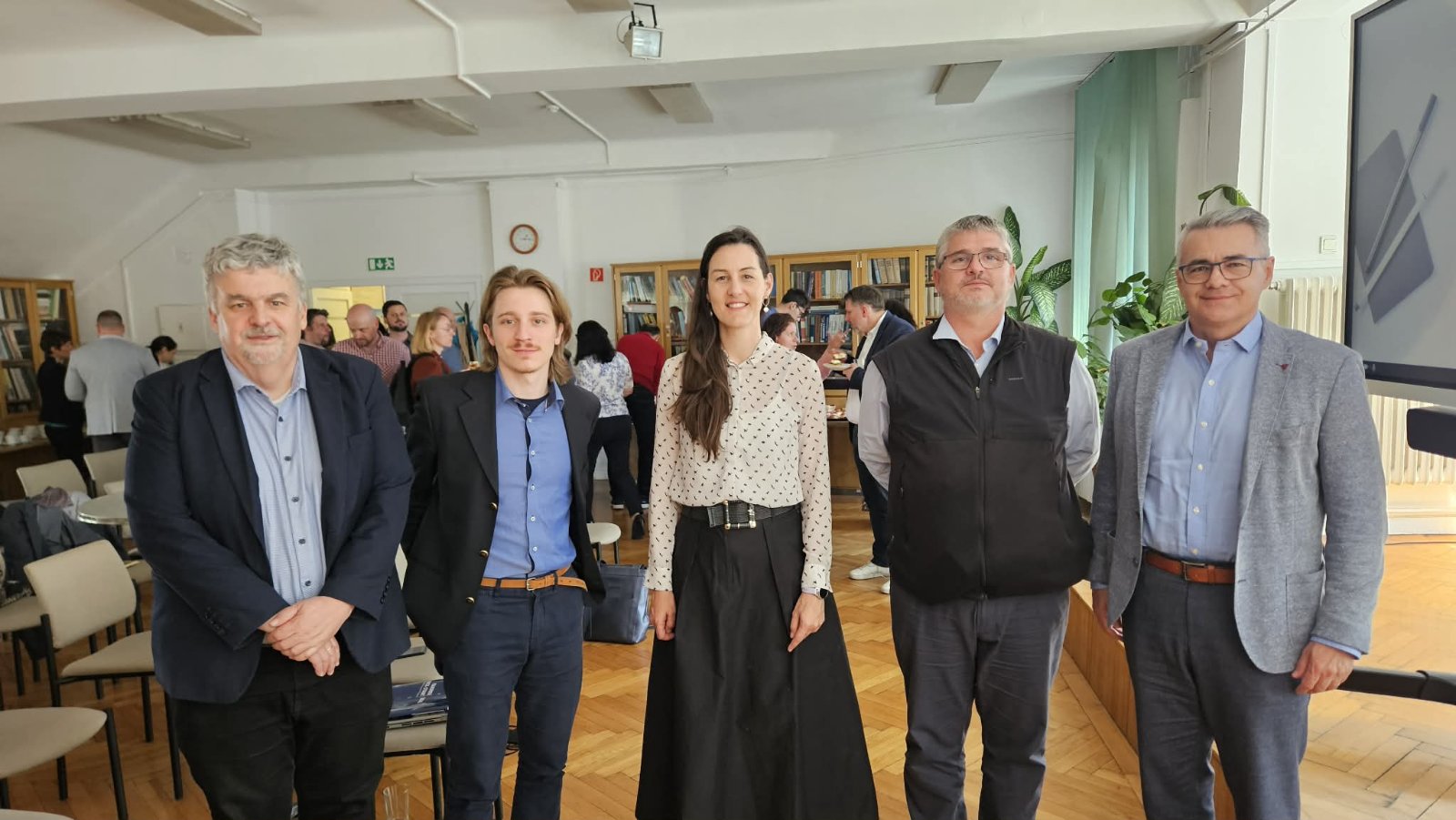
On April 29, 2026, a professional workshop on the agricultural applications of artificial intelligence (AI) was held at the AKI building. The event was organized in cooperation with the Innovation and Digitalization Support Unit (ITE), the Hungarian Association for Precision Livestock Farming (MAPÁE), and the Hungarian Precision Agriculture Association (MPGE). During the event, it became clear that the successful implementation of AI does not begin with modelling, but with the availability of the right quantity and quality of data. A summary of the presentations can be read below.
Lívia Kránitz (ITE): AI Trends and Regulation in the EU
The EU’s AI strategy is built on a balance between stimulating innovation and creating a safe environment. The AI Office is responsible for implementing the new AI Act, supported in its operations by advisory forums, scientific bodies, and the AI Board, which is composed of Member State representatives. At the Member State level, market surveillance authorities will act as the primary coordinating bodies. The regulation applies a unique, risk-based approach. Different requirements enter into force for various risk levels. Innovation is stimulated by a comprehensive package: data supply is ensured through common data spaces, processing through supercomputer-powered “AI Factories”, and financing via funds worth hundreds of millions of euros. The work of Hungarian developers will also be supported by experts from the domestic European Digital Innovation Hub for AI (AI EDIH) and a central regulatory sandbox. In her presentation, Lívia Kránitz pointed out that the appearance of high-risk AI systems in the agrifood economy will require increased attention from the agricultural administration.
The first and second parts of the presentation are available on the MPGE Facebook page.
Miklós Maróti and Marcell Kóbor (AgroVIR): Application of AI in AgroVIR Services
AgroVIR has launched its AI catch-up process on multiple fronts. Clients’ digital transition is supported by a chatbot that allows farmers to ask questions during data entry without feeling embarrassed. The work of machinery operators is supported by a speech-to-text module for logging daily operations, while another module creates a database of field-level meteorological data that is updated every 10 minutes. In addition, the crop price forecasting system can project 12-month market trends. Their largest development, however, is a digital assistant built on a 700,000-hectare dataset, which performs two main functions: it generates reports and provides support in interpreting business data, and it performs validated benchmarking based on community data.
The presentation can be viewed here.
Tünde Fórián, KITE Zrt.: On KITE’s AI Usage (PGR)
KITE’s PGR system is a digital ecosystem that organizes arable-farming data into a grid with a 10-meter resolution. The background of the system is provided by a vast data asset compiled from satellite imagery, meteorological station measurements, and precision machinery data. This forms the basis for AI-based national yield estimation, climate stress estimation, pest monitoring, and automated zone delineation. According to KITE’s experience, data quality is one of the critical factors for success. At the same time, filtering data prior to input and training models require significant resources, as truly effective AI development necessitates building a server infrastructure and preparing the internal expert team.
Click here to view the presentation.
Gábor Asztalos (Nemzeti Ménesbirtok és Tangazdaság Zrt.): Digitalisation, Data Management, and Preparation for AI Adoption, Presented through the Lens of Crop Production and Livestock Farming
One of the main takeaways from this presentation is that the key to AI-based efficiency improvement lies in structuring data and creating a common professional language between the agricultural sector and IT developers. At Ménesbirtok, the livestock sector has focused on optimising feed consumption over several years. Through the development of 5G-enabled cameras and algorithms, they generated accurate estimates of the quantities available on the feed bunk, thereby significantly reducing waste and labour requirements. In crop production, they have developed an integrated information platform that combines cloud-based machinery data, drone surveys, as well as soil and financial indicators. The system allows decision-makers to click on a specific field and simultaneously view both the technological parameters and the profitability of that area.
Click here for further details.
Lilla Csige (CAD+Inform Kft.): Plant- and Product Chain-Level “Digital Twin” Systems in Food Value Chains
The purpose of the process simulation, based on the British Witness software, is to create a digital twin. This means a computer-generated copy of reality which, in the case of a factory, for instance, can forecast future events and machinery breakdowns. By examining thousands of scenarios, the system automatically searches for the optimum and flags risks. In recent years, the entire production chain of a feed mixer has been made transparent, while a slaughterhouse model has provided accurate forecasts regarding worker utilisation and the expected completion of the production plan. With the simulation, the inventory trends and profitability of an entire corporate group can also be tracked.
The full presentation is accessible here.